
What’s Inside
A Colorado family law attorney explains why this viral term has real legal stakes — and what to do if it happened to you.

Social media is calling it “alpine divorce”: one partner takes the other into a remote outdoor setting, then leaves them there. The term is new, but the behavior is not.
In recent weeks, TikTok and social media have surfaced thousands of accounts from people who experienced exactly this — abandoned on trails, in wilderness, or in isolated terrain by romantic partners. The phrase itself traces back to Robert Barr’s 1893 short story An Alpine Divorce, in which a husband plots to push his wife off a cliff in the Alps.
As a Colorado family law attorney, I do not see this as internet theater. I see it as a useful name for conduct that can intersect with criminal exposure, civil protection orders, and family-court questions about coercive control and judgment. Let me break down what the law actually says about Alpine Divorce — and what you can do if this has happened to you.
What “Alpine Divorce” Actually Describes
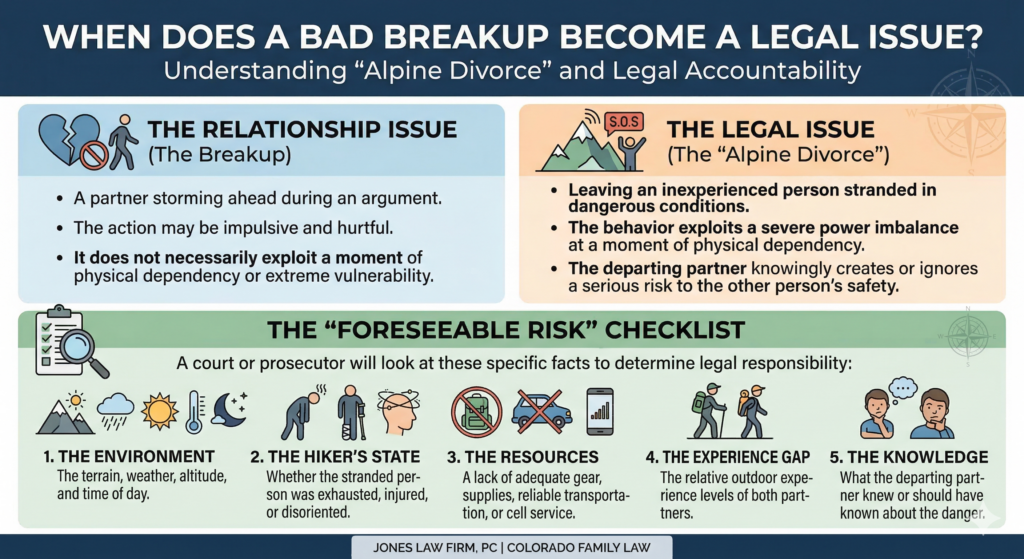
At its core, the term describes one partner abandoning the other in a setting where they’re newly vulnerable: far from help, without reliable transportation, without adequate gear, beyond their physical capacity, or without cell service. The abandonment may be impulsive or calculated. It may be a single incident or part of a longer pattern. What unites the accounts isn’t the geography. It’s the power imbalance, exploited at a moment of physical dependency.
That distinction matters legally. A partner storming ahead during an argument is one thing. Leaving an inexperienced person stranded in dangerous conditions is another. The legal analysis turns on specific facts: terrain, weather, altitude, time of day, injury, supplies, relative experience, and what the departing partner knew or should have known.
That is why this should not be trivialized as a quirky breakup trend. It is about foreseeable risk — and who bore responsibility for it.
CASE IN POINT: AUSTRIA, 2025–2026
In January 2025, Thomas Plamberger left his girlfriend near the summit of Grossglockner — Austria’s highest mountain — in freezing conditions without adequate gear. She did not survive. In February 2026, an Innsbruck court convicted him of gross negligent manslaughter. The court found that as the more experienced mountaineer, he had a duty of care and should have recognized much earlier that she could not safely complete the climb. He was held responsible not because he intended harm, but because a reasonable person in his position would have foreseen it. That is the legal standard alpine divorce bumps up against.
When Abandoning a Partner Outdoors Becomes a Legal Issue
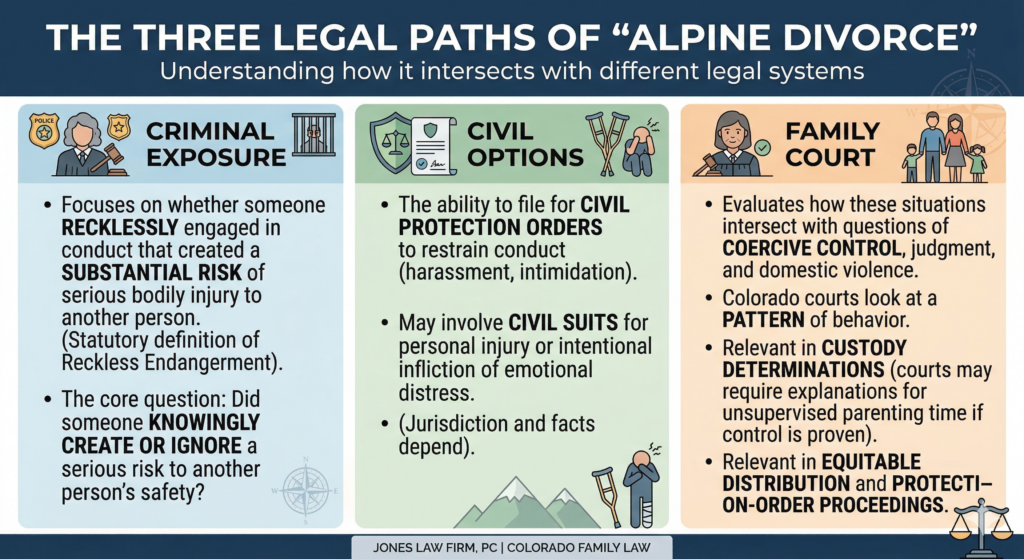
In Colorado, reckless endangerment means recklessly engaging in conduct that creates a substantial risk of serious bodily injury to another person. That is not a loose standard — it is a statutory one.
That does not mean every “alpine divorce” incident would support criminal charges. But it does mean the law is asking a more concrete question than people often assume: did someone knowingly create or ignore a serious risk to another person’s safety? A court or prosecutor would look at things like:
• Did the person know the other hiker was exhausted, injured, disoriented, or unable to get back safely on their own?
• Did they leave anyway — or fail to call for help, provide accurate information, or respond appropriately once danger became obvious?
• Were the conditions — altitude, weather, time of day, terrain — such that a reasonable person would have recognized serious risk?
Beyond criminal exposure, these situations can also intersect with civil protection orders, civil suits for personal injury or intentional infliction of emotional distress, and — critically — family court. These are distinct legal paths, and which one applies depends on the specific facts and jurisdiction.
“The law does not require intent to cause harm. It only requires that you ignored a foreseeable risk of it.”
Alpine Divorce as Coercive Control — and Why It Matters in Family Court
Not every alpine divorce ends in criminal court. Many exist in a grayer zone: a controlling partner who consistently pushes beyond the other’s physical limits outdoors, dismisses their distress, and uses remote settings to assert dominance or manufacture dependency.
Colorado courts are increasingly being asked to look at behavior in pattern form, not just incident form. Colorado House Bill 24-1350, which became law in 2024, defines coercive control as a pattern of threatening, humiliating, or intimidating actions used to harm, punish, or frighten an individual. It also requires courts, in certain circumstances, to explain on the record why unsupervised parenting time is in a child’s best interests when there is credible evidence that a parent has engaged in domestic violence, child abuse, or coercive control.
If a partner uses risk, fear, and physical vulnerability as tools of control — whether on a mountainside or in the home — that conduct can become relevant in custody determinations, protection-order proceedings, and equitable distribution. Documented patterns of outdoor intimidation, isolation, and reckless disregard for safety are exactly the kind of evidence family courts are now being asked to weigh.
Colorado’s protection-order system is also broader than many people realize. Protection orders can cover a wide range of conduct beyond physical assault — including harassment, intimidation, stalking, and other conduct courts deem appropriate to restrain. They can be filed in any county where the incident occurred, where either party lives, or where either party is employed.
“When thousands of people recognize their own story in a viral post, that’s not a trend. That’s an undercounted pattern finally finding its voice.”
What to Do If This Happened to You
If a partner has ever left you in a dangerous setting and you are wondering whether it “counts,” the short answer is: it does not need to fit a specific legal definition for you to take it seriously. Start here.
1. Get safe first. If there is any immediate risk, prioritize distance, transportation, shelter, and medical care over evidence collection. Safety before documentation.
2. Write down the facts while they’re fresh. Document the date, location, weather, time of day, what was said before and after, what gear you had, whether you had service, and how you got back. Save texts, photos, maps, and call logs. Screenshots of social posts or messages are often useful in court.
3. Look at the pattern, not just the incident. Was this person often dismissive of your physical limits? Did they isolate you from others, pressure you, mock your fear, or create situations where you depended on them for safety or transportation? Pattern changes everything — legally and relationally.
4. Talk to an advocate or attorney. The National Domestic Violence Hotline provides confidential support 24/7 by phone (1-800-799-7233), chat, and text. Many Colorado family law attorneys, including our firm, offer free initial consultations. Even if you are not ready to leave the relationship, a consultation can clarify how an incident like this might affect future custody, protection orders, or divorce proceedings.
5. Consider creating a formal record. If the incident involved serious danger or injury, a police report or protection-order filing may matter later — in both criminal and family court. In Colorado, you can file a civil protection order without an attorney and without pressing criminal charges. A record created now protects options you may need later.
COMMON QUESTIONS
No. It originated as a social media phrase. But the conduct it describes — abandoning a partner in a dangerous environment — can fall under existing criminal statutes, civil protection laws, and family court standards.
Not automatically. Courts look at the full picture: terrain, weather, experience levels, available gear, cell service, and what the departing person knew or should have known. The legal question is whether a reasonable person would have recognized a serious risk.
In many states, including Colorado, patterns of intimidation, reckless disregard for safety, and coercive control can support findings of abuse even without physical injury — particularly in family court and protection-order proceedings.
It may still be legally relevant, particularly in divorce, custody, or protection-order proceedings. Document what you remember and consult a family law attorney about statute of limitations and how prior conduct affects current proceedings.
The Bottom Line
Naming a pattern is only useful if it leads somewhere. So let me be direct about where this should lead.
If something in this article felt familiar, your first job is to be honest with yourself about what you’re dealing with. Not whether it meets a legal standard — that’s my job. Yours is to look at the full picture: not just the incident, but the pattern around it. A partner who consistently disregards your physical limits, isolates you, or creates situations where you have no good options is showing you something important. Believe it.
Your second job is to get informed before you need to be. A consultation with a family law attorney isn’t a dramatic step — it’s a practical one. It tells you what your options are, what the law in Colorado actually covers, and what documentation would matter if you ever need it. You don’t have to be ready to file anything to have that conversation. You just have to be willing to know.
Safety first. Then clarity. Then, if and when it’s right, action. That’s the sequence — and an attorney can help you figure out where you are in it.
If a partner has left you stranded outdoors, or if you recognize a pattern of conduct that feels like coercive control, Jones Law Firm, PC can help you understand your legal options in a confidential consultation.
About the Author
April D. Jones, Esq. is the Founder and CEO of Jones Law Firm, PC, a Colorado family law firm with offices in Centennial and Denver. She has been a practicing attorney since 1991, holds a Super Lawyers designation, and serves as incoming Vice President of the Colorado Bar Association. Her practice focuses on high-conflict divorce, domestic abuse, and coercive control matters, including protection orders, custody, and post-decree enforcement. She regularly serves as a legal resource for journalists covering domestic violence, family law trends, and emerging relationship dynamics.
This article is for general informational purposes only and does not constitute legal advice. Consult a licensed attorney in your jurisdiction for advice specific to your situation.
