


Understanding Divorce With Children in Colorado
Divorce is more than a legal process. It is a life transition that reshapes how families live, communicate, and plan for the future. For many people, divorce begins with a mix of fear, confusion, and exhaustion. You may feel like everything familiar has been taken apart and no one handed you a map. That is exactly why understanding how divorce works in Colorado matters. Knowledge creates steadiness. And steadiness is what courts reward and what families need most.

How Divorce Works in Colorado
Colorado is a no-fault divorce state. That means you do not have to prove wrongdoing such as infidelity or abandonment to end your marriage. The only legal ground needed is that the marriage is irretrievably broken, meaning there is no reasonable chance of reconciliation. This standard protects privacy and keeps the focus on practical decisions instead of blame.
To file for divorce, officially called a dissolution of marriage, at least one spouse must have lived in Colorado for 91 days before filing. Either spouse can start the process by filing a petition in district court. Once the papers are served on the other spouse, the law requires a 91-day waiting period before the divorce can be finalized. That time gives the court and the parties space to resolve finances, property division, and issues involving children.
The Role of the Court
The court’s role is not to punish or reward either spouse. It is to create an order that fairly divides property, addresses financial responsibilities, and ensures that any children have stable, safe environments. Judges in Colorado use well-established statutory guidelines for dividing marital property, determining maintenance (spousal support), and resolving parental responsibilities.
Much of the divorce process happens outside the courtroom. Most cases are resolved through negotiation, mediation, or settlement conferences. These approaches allow families to keep more control over the outcome and reduce the emotional toll of litigation. Judges generally favor parties who demonstrate reasonableness and preparation because it signals maturity and maturity protects children and assets alike.

Divorce and Parenting in Colorado
When a divorce involves children, the court must also address parenting time and decision-making. These issues are handled under Colorado’s allocation of parental responsibilities laws, the same framework explained in depth in Jones Law Firm’s Guide to Child Custody in Colorado. Judges want to see stability, cooperation, and child-centered thinking. Even in divorce, parents remain a team in the eyes of the court when it comes to raising their children.
Financial Realities of Divorce
Money is one of the most stressful aspects of divorce. Colorado law follows the principle of equitable distribution, meaning assets and debts acquired during the marriage are divided fairly, though not always equally. The court considers the contributions of each spouse, both financial and non-financial, as well as future earning potential and economic circumstances.
Spousal maintenance, sometimes called alimony, may be ordered to help balance financial disparities, especially when one spouse supported the household or paused their career during the marriage. Colorado uses advisory formulas for maintenance, but judges retain discretion to adjust based on the facts of the case.
Transparency is key. Hiding assets or misrepresenting finances can destroy credibility. Courts value honesty and documentation over strategy or manipulation. The spouse who approaches financial disclosure with clarity and organization usually gains trust and better results.
Emotional and Practical Preparation
Divorce is not just about paperwork; it is about people. The emotional impact can cloud judgment and prolong conflict. That is why preparation matters. Create organized records. Keep communication calm and brief. Document parenting involvement. Seek professional counseling or coaching if needed. The court will not measure your pain, but it will notice your stability.
Clients often ask what the “right” way to behave during divorce is. The answer is simple: focus on what you can control. Show the court that you are steady, informed, and guided by your child’s and your own long-term well-being. Those qualities are noticed and they carry weight.
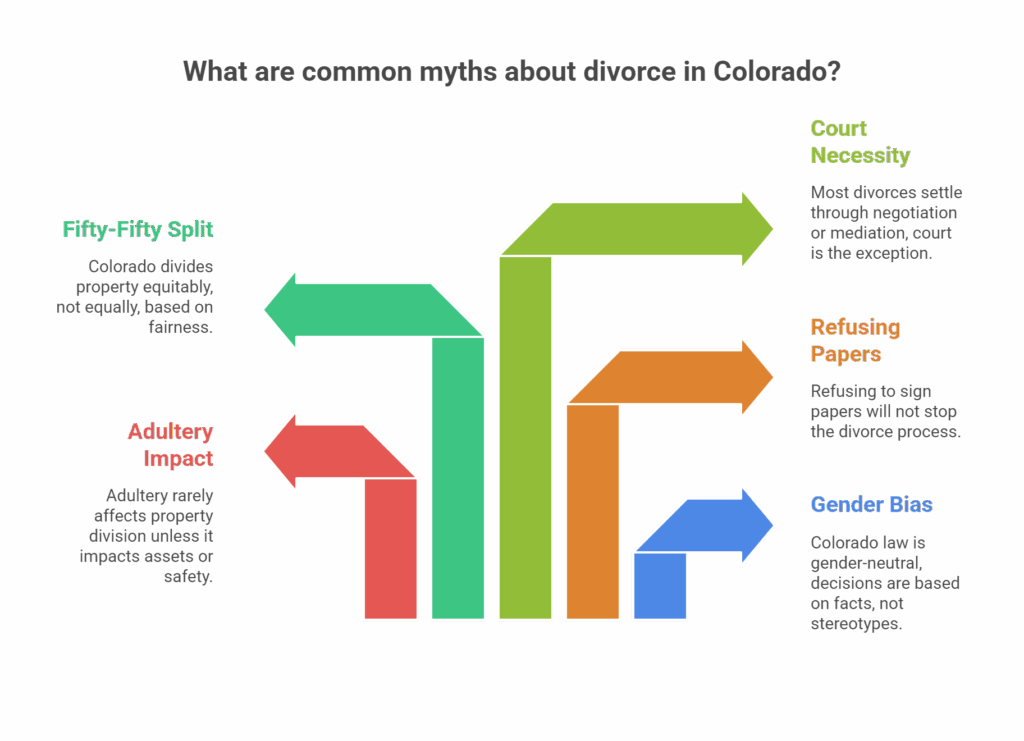
Common Myths About Divorce in Colorado
Myth 1: Colorado favors mothers in divorce.
Truth: The law is gender-neutral. Decisions about property, support, and parenting are based on facts, not stereotypes.
Myth 2: Adultery or bad behavior automatically affects property division.
Truth: Because Colorado is a no-fault state, misconduct rarely impacts financial outcomes unless it directly affects marital assets or safety.
Myth 3: You can refuse to sign divorce papers to stop the process.
Truth: Once one spouse files and meets residency requirements, the divorce will proceed even without the other parties agreement or participation.
Myth 4: Everything is split fifty-fifty.
Truth: Colorado divides property equitably, not equally. Fairness is based on contributions, needs, and the specific circumstances of each case.
Myth 5: You have to go to court for every disagreement.
Truth: Most divorces settle through negotiation or mediation. Litigation is the exception, not the rule.
Frequently Asked Questions
How long does a divorce take in Colorado?
The minimum is 91 days, but complex cases involving assets or children can take several months to more than a year.
Can we use the same lawyer?
No. Even if your divorce is amicable, one attorney cannot ethically represent both parties. However, you can work collaboratively with neutral mediators.
What happens if my spouse will not disclose finances?
You can request formal discovery through the court. Judges take transparency seriously, and hiding assets can result in penalties or unfavorable rulings.
Will the court consider who was at fault for the breakup?
No. The focus is on practical outcomes, not assigning blame.
Can we change our divorce agreement later?
Certain orders, such as parenting time or maintenance, can be modified if circumstances change significantly.
Does it matter who files first?
No. Filing first does not affect custody, property division, or support outcomes.
Can parents have an uncontested divorce with children?
Yes. Parents may submit a full agreement on custody, support, and property for court approval.
Is mediation required?
Often yes. Courts generally require mediation before contested hearings, especially for parenting issues.
What is an initial status conference?
An early court meeting where deadlines are set and the judge reviews case progress.
Can one spouse stop the divorce by refusing to sign?
No. Once a petition is filed and residency requirements are met, the case moves forward.
Which county should the divorce be filed in?
Typically the county where either spouse resides.
Looking Forward
Understanding the foundation of Colorado divorce law is the first step in regaining control of your future. The process may feel uncertain, but knowledge turns fear into direction. The next chapter explores how to prepare for divorce before filing and the documents, decisions, and strategies that can help you protect what matters most from the very beginning.
Call us directly at 720-708-2475.