


A Colorado court cannot grant your divorce, formally a dissolution of marriage, until 91 days after your spouse is served, signs a waiver or joins a joint filing. You are ending a marriage, and filing starts the case, not the clock.
You control three things: the right court, accurate forms and your conduct after filing. Here is how divorce works in a Colorado district court, from eligibility to records. Start with a pre-filing checklist so your finances are documented first.
Since 2000, our attorneys have handled more than 4,000 family law matters across Arapahoe County. Under our Communication Guarantee, we update you proactively.
Ready to take the first step? Talk with Jones Law Firm PC about your Colorado divorce and get a filing plan built around your goals.
Key Takeaways
- A Colorado divorce cannot be final until at least 91 days after service, a signed waiver or a joint filing. Filing alone does not start the clock.
- You file in the district court of the county where either spouse lives, once at least one spouse has lived in Colorado for 91 days.
- Once the case is filed, an automatic temporary injunction bars both spouses from moving, hiding or borrowing against property or changing insurance.
How Do You File For Divorce In Colorado?
You file in five steps:
- Qualify: meet the residency rule.
- File: submit a Petition for Dissolution of Marriage in the correct district court.
- Pay or waive: cover the filing charge or ask the court to excuse it.
- Serve: deliver the papers to your spouse or get a signed waiver.
- Disclose: exchange financial records within 42 days of service.
Under C.R.S. 14-10-106, the residency requirement is 91 days of Colorado domicile for at least one spouse before filing. The only ground is irretrievable breakdown, meaning the marriage cannot be repaired.
Filing first gives no legal advantage. The judge applies the same rules to both spouses.
Which Forms Start A Colorado Divorce Case?
Five core documents start a Colorado divorce case, each with its own signer and timing:
- Petition for Dissolution of Marriage: requests property division, maintenance (commonly called alimony) and allocation of parental responsibilities (commonly called custody). The filer signs, or both spouses sign as co-petitioners. Filed on day 0.
- Summons: tells your spouse about the case and the response deadline. The filer signs. Served with the petition, and not needed in a joint filing.
- Case information sheet: the court’s intake summary. The filer signs. Filed with the petition.
- Sworn financial statement: income, expenses, assets and debts under oath. Each spouse signs their own. Due within 42 days of service.
- Motion to File Without Payment: asks the court to excuse the filing charge. The requesting spouse signs under oath. Filed with the petition or response.
Forms are revised, so confirm current versions on the Colorado Judicial Branch website. Our team will draft and file all required pleadings, affidavits, and proposed orders.
Both spouses complete sworn financial statements, even in agreed cases. The court uses them to check that the terms are fair.
How Does A Joint Petition Work?
A joint petition means both spouses sign one petition as co-petitioners. No service is needed, and the 91-day clock starts at filing.
It fits only when you both agree to file, which is the usual start of an uncontested divorce. Under C.R.S. 14-10-112, a signed separation agreement binds you unless the court finds it unconscionable, meaning grossly unfair.
When Does One Spouse File Alone?
One spouse files alone when the other will not co-sign, cannot be reached, or when early protection matters. That spouse must then serve the petition or obtain a signed waiver.
In contested, high-asset, gray (spouses over 50) and military cases, disclosure and evidence mistakes in the first 90 days do the most damage. We recommend filing only after your financial picture is documented.
Where Do You File Along The Front Range?
You file in the district court of a county where either spouse lives. For most metro filers, that is one of five courts:
- Arapahoe: 18th Judicial District Court (Arapahoe County), Centennial, for Greenwood Village, Centennial, Englewood and Aurora’s Arapahoe portion.
- Douglas: Douglas County District Court, Castle Rock, for Parker and Highlands Ranch.
- Jefferson: Jefferson County District Court, Golden, for Lakewood and Westminster’s Jefferson portion.
- Denver: Denver District Court, for Denver.
- Adams: Adams County District Court, Brighton, for the Adams portions of Westminster and Aurora.
Aurora spans Arapahoe, Adams and Douglas counties. Westminster spans Adams and Jefferson. Your home address, not your city name, picks the county, so check your property tax record, then confirm courthouse and e-filing details with the clerk.
What Does Colorado District Court Charge To File?
The district court charges a set petition filing amount from the Colorado Judicial Branch’s published schedule, and the responding spouse pays a separate response charge. Service adds an amount based on the method. Check the schedule the day you file, because the amounts may change in 2027.
Four early charges apply:
- Petition filing: paid by the filer at filing.
- Response: paid by the respondent with the response.
- Sheriff or private process server: charged per delivery.
- Waiver of service: no charge.
No money does not end the case. The court decides a Motion to File Without Payment based on your income and public benefits, and a denial means paying by a set deadline.
Which Service Methods Add Charges?
Sheriff service and a private process server charge. A signed waiver of service does not.
Service is formal notice, delivered with the petition and summons unless your spouse signs a waiver. A waiver starts the 91-day clock when signed, so it is the fastest route when your spouse cooperates.
How Does A Motion To File Without Payment Work?
You ask the court to excuse the filing charge based on your income and public benefits, with sworn financial information.
If the court grants it, your case proceeds without the charge. If it denies the motion, you pay by the deadline it sets, or the case stalls.
When Can A Colorado Divorce Be Final?
A Colorado divorce can be final no earlier than 91 days after service, a signed waiver or a joint filing, under C.R.S. 14-10-106(1)(a)(III). The filing date does not count.
Ninety-one days is a floor. No Decree of Dissolution of Marriage, the court’s final order, enters until every issue is agreed or decided. The stages after the floor appear in a fuller divorce timeline.
What Starts The 91-Day Clock?
Service on your spouse, a signed waiver or a joint filing starts the 91-day clock. Filing alone does not, because the statute counts from when the court gains power over your spouse.
Say you file March 1 and your spouse is served in Colorado on March 10. The response is due March 31 (day 21), or April 14 (day 35) for out-of-state service. Disclosures are due April 21 (day 42), near the initial status conference.
The earliest decree is June 9, day 91 from service. Counting from filing gives May 31, a date the court cannot use.
Which Deadlines Fall Before The Decree?
Two deadlines come first: a response within 21 days of in-state service or 35 days out of state, then mandatory disclosures within 42 days of service. Response periods come from C.R.C.P. 12, and disclosures from C.R.C.P. 16.2(e).
The initial status conference lands around day 42. It sets deadlines and screens for temporary orders, which cover parenting time and support while the case is pending.
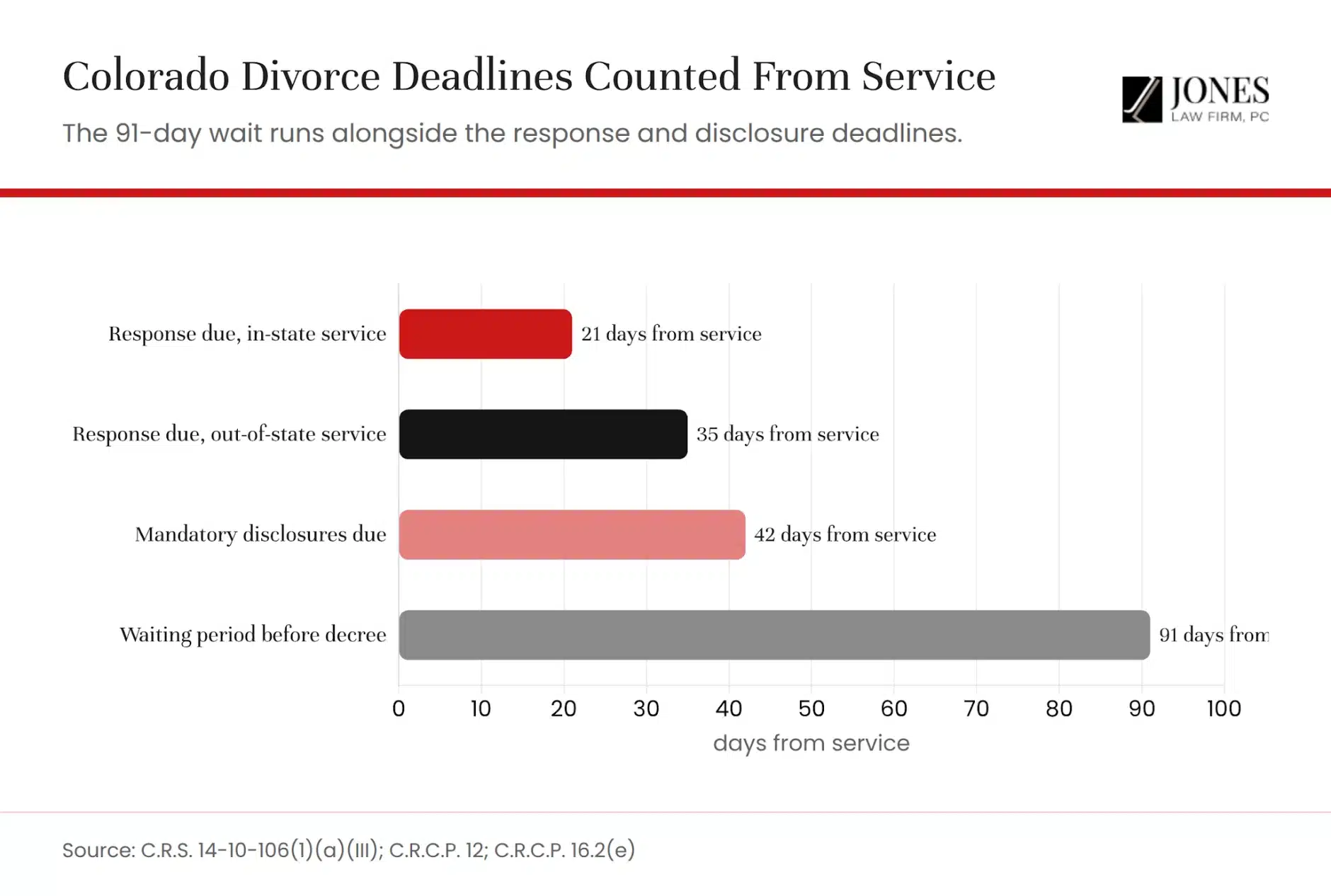
Figure 1: The earliest decree date is day 91 from service, long after the response and disclosure deadlines pass. Source: C.R.S. 14-10-106(1)(a)(III); C.R.C.P. 12; C.R.C.P. 16.2(e).
What Can You Not Do After Filing?
An automatic temporary injunction under C.R.S. 14-10-107(4)(b)(I) bars both spouses from transferring, encumbering (borrowing against), concealing or disposing of property, or changing insurance coverage or beneficiaries. It binds the petitioner on filing and the respondent on service.
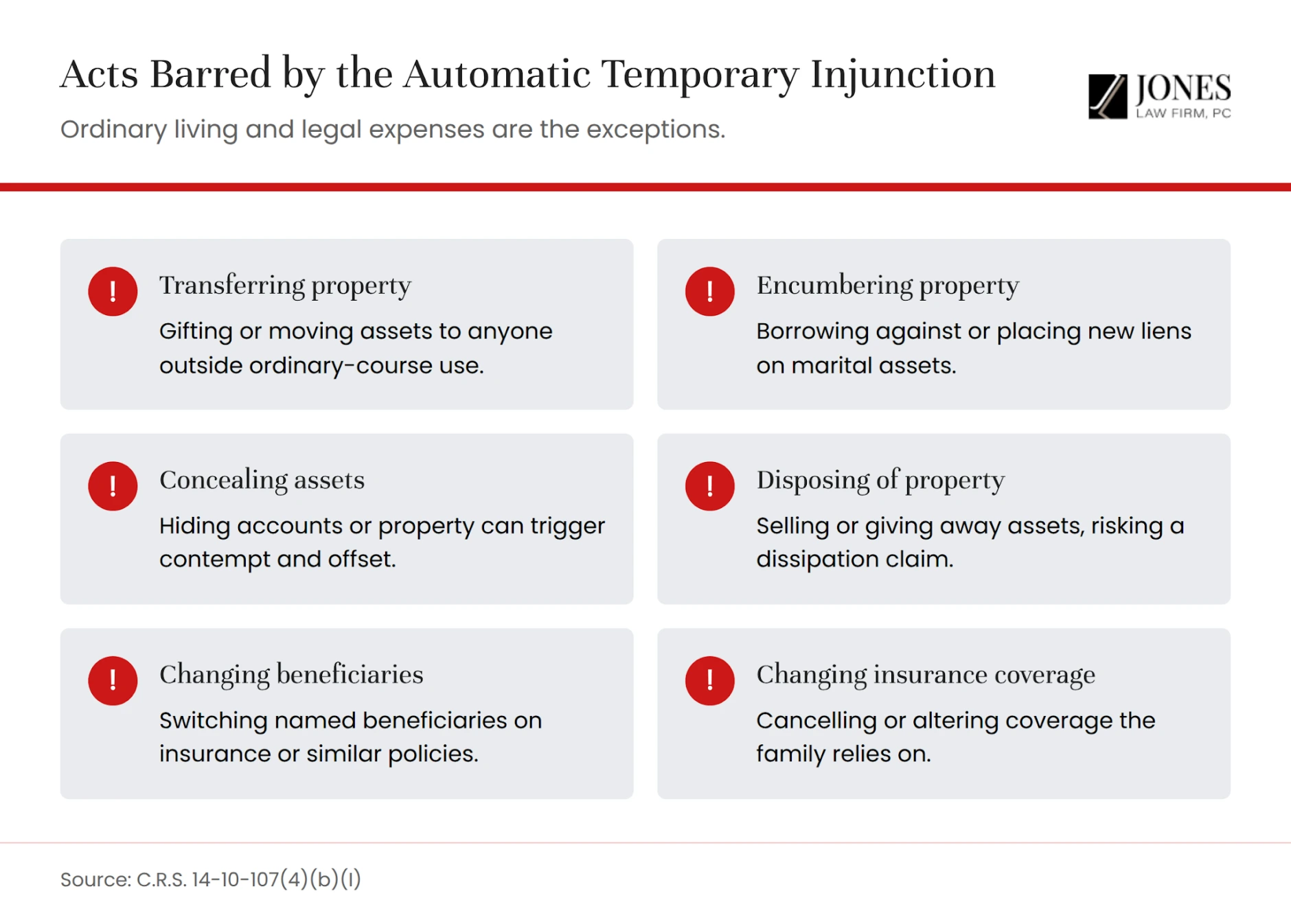
Figure 2: Moving, hiding or re-titling property or insurance after filing invites contempt or an offset claim. Source: C.R.S. 14-10-107(4)(b)(I).
Start Your Colorado Divorce With A Clear Plan
Filing for divorce in Colorado comes down to a few early decisions: confirming residency, choosing the right district court, filing accurate forms and following the automatic temporary injunction once the case begins. The 91-day clock runs from service, a signed waiver or a joint filing, and every deadline after that depends on getting the first steps right.
Jones Law Firm PC has handled more than 4,000 family law matters since 2000. Schedule a consultation with our team to review your finances, confirm where to file and map out each stage of your case.
We choose sides. Yours.